This post is made possible with support from the American Academy of Pediatrics through a cooperative agreement with the Centers for Disease Control and Prevention. All opinions are my own.
If you've been hanging out online with me for any length of time, you know I love sharing resources for a fun, happy home. Today I'm going to veer off to talk about something near and dear to my heart: Adverse Childhood Experiences (ACEs) and what we can do to prevent them!
I have 5 amazing kids. They all joined our family at different ages and have varying backgrounds, but one thing they all have in common is that they joined our family through adoption and that their early lives weren't easy.
They all experienced Adverse Childhood Experiences (ACEs) that I wish they hadn’t experienced. And while it's easy to point fingers and blame, the reality is this: We all have a responsibility to do what we can to assure safe, stable, nurturing relationships and environments for all children.
What Are ACEs
Adverse Childhood Experiences (or ACEs) are potentially traumatic events that occur in childhood. These can include things such as child abuse, child neglect, mental illness in the home, a parent or other member of the household with a substance abuse problem, witnessing domestic violence, the death of a parent or sibling and parent separation or divorce. Events like these are far more common than you think and can lead to increased risk of teen pregnancy, substance abuse, depression and more.

Early childhood experiences shape the architecture of the developing brain. Brain development happens sequentially, and if the process is impaired, children will have a weaker foundation for development and growth. When a child is repeatedly exposed to adversity, a child's stress response can be wired to be on high alert all the time. This compromises the way the brain develops and results in social, emotional, and cognitive impairment. This also affects the immune system.
When one of our kiddos moved in with us, their immune system and gut health were so compromised that they were sick for the entire first year they lived with us. They also couldn't eat most foods without getting sick. Poor nutrition coupled with violence and neglect had created a body and brain that was out of control. And the reality is that these effects don't go away overnight.
Poor adult health outcomes have long been linked to ACEs such as violence and trauma. There is a link between ACEs and the following health conditions:
- Depression
- Chronic Obstructive Pulmonary Disease
- Asthma
- Kidney Disease
- Stroke
- And so many more
And here’s the thing: If we could address ACEs, we could reduce the number of adults with depression by 44%. That's a staggering number!
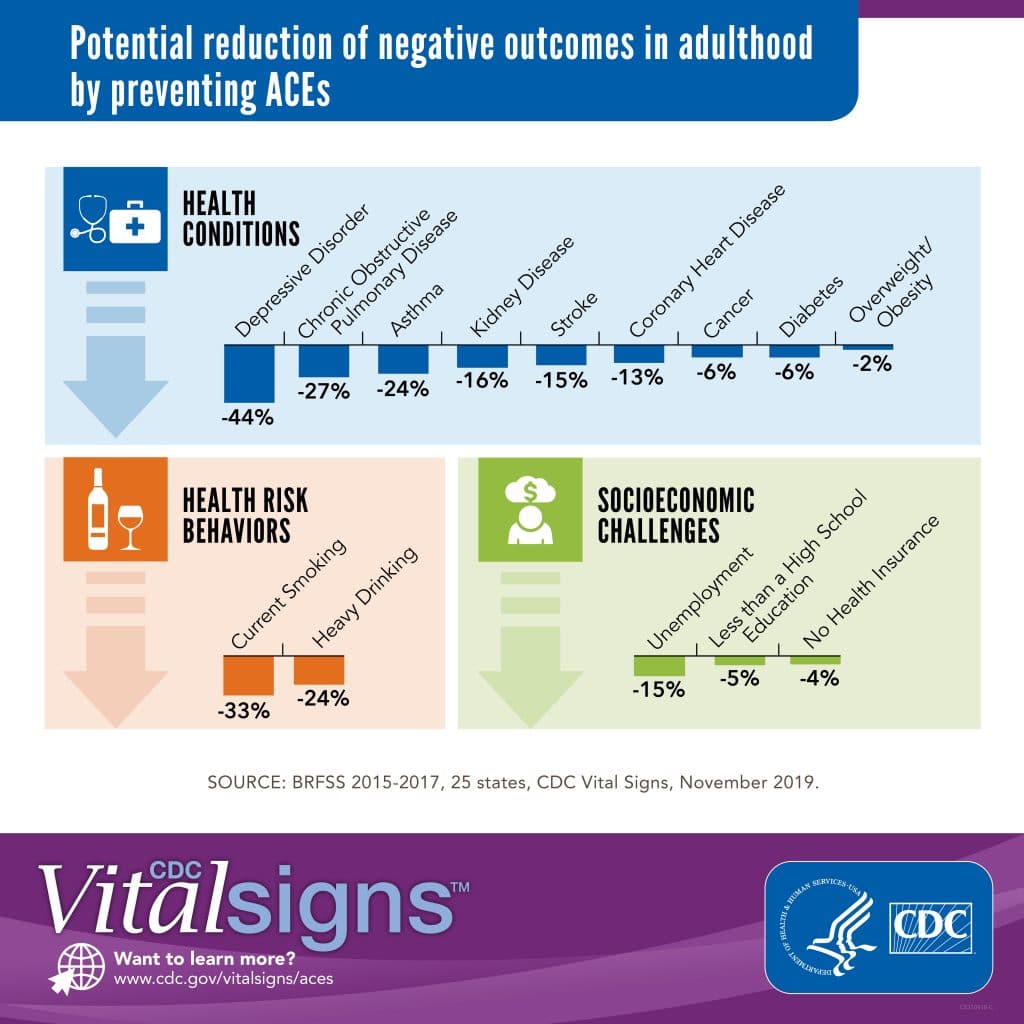
If we could address ACEs, we could reduce the number of adults with depression by 44%. That's a staggering number!
How Can We Prevent Adverse Childhood Experiences
As I said earlier, it's easy to point fingers and assign blame, but the reality is that it takes a community to help eradicate ACEs.
Parenting is hard. And when you add adverse community environments to the mix, parenting can feel impossible. It's hard to raise children in a safe, stable, nurturing environment when you're also struggling with poverty, lacking affordable housing, and dealing with discrimination.
Maybe you don't have family around to watch kids when they're sick and you're stuck between a rock and a hard place because you know that missing work to care for a sick child will mean the loss of a job… which could then lead to the loss of housing.
Every person can make a difference when it comes to ACEs. I fervently believe this. I'm sure you've heard the African proverb, “It takes a village to raise a child.” This phrase comes from the Nigerian Igbo culture and means that an entire community of people must interact with children for those children to experience and grow in a safe and healthy environment. You and I need to find those people, and you and I need to be those people.
#FindYour3
If every parent identified 3 people or resources they could rely on to help them create safe, stable, and nurturing environments and relationships for their kids, it would go a long way toward eradicating ACEs. Alternatively, you can become part of someone's 3 and can help provide the vital support they need to parent well and to ensure that their kids have safe, stable, and nurturing environments and relationships.
I know firsthand how important it is to find your 3. I found my 3 (and honestly, I’ve been fortunate as I now have more than 3) through our church, through our kids’ school, and through adoption and foster care communities that I’m involved in. We’ve also had amazing coaches who have invested in our kids as athletes and as people.
How Will You Make A Difference
Like I said earlier, I fervently believe you and I have the power to make a difference and help address ACEs. Spend time learning more about ACEs and leave me a comment with resources that you've found helpful or ways that you will be part of someone's 3.
